
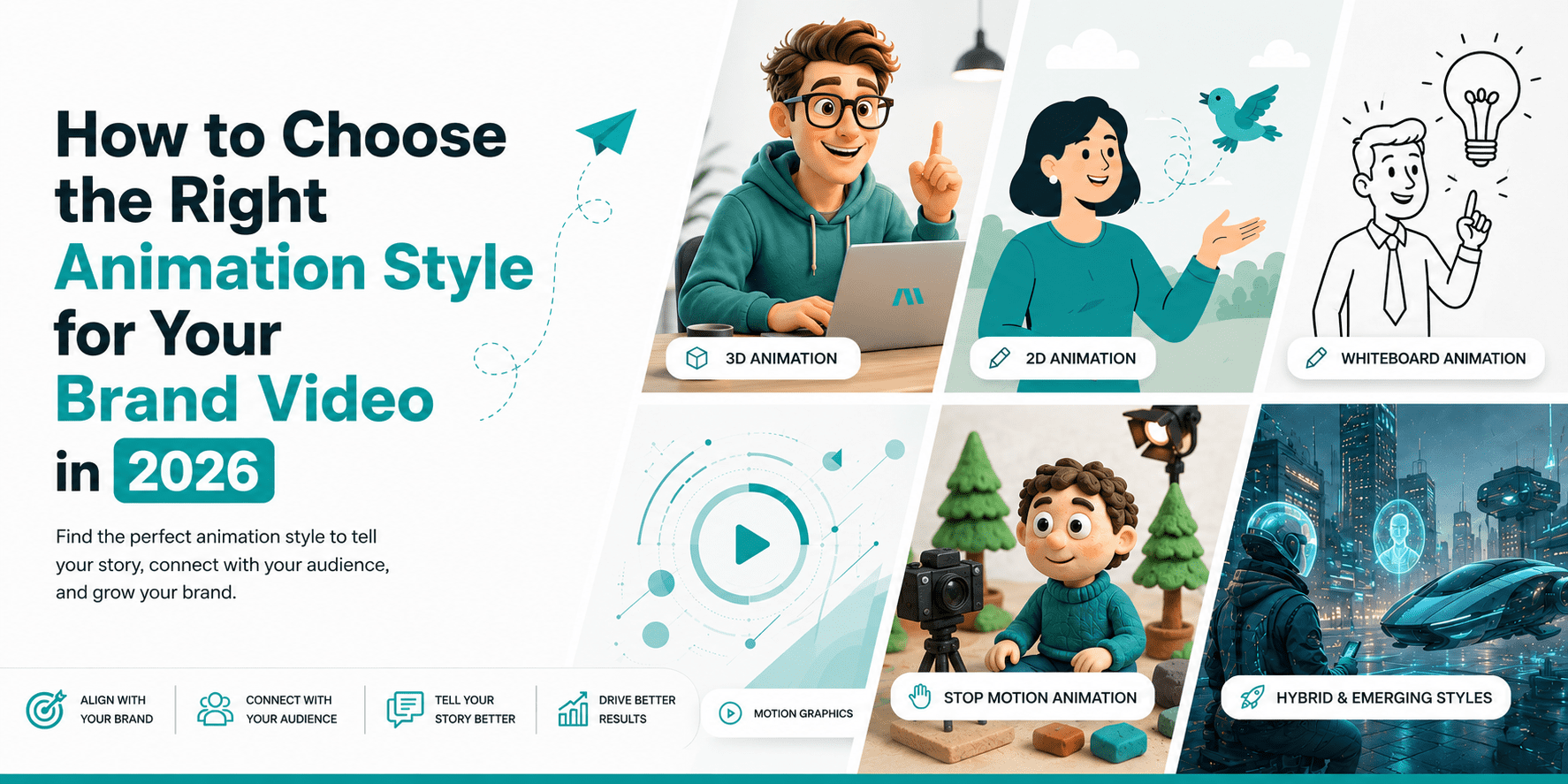
Choosing the right animation style for your brand video feels simple until you’re 17 tabs deep comparing 2D animation, cinematic 3D renders, motion graphics, and whiteboard explainers that somehow still exist from 2014.
But here’s what those tabs won’t tell you: 91% of businesses now use video as a marketing tool, and 63% of consumers say a short video is their preferred way to learn about a product.
The wrong animation style can make even a great brand feel awkward. Like showing up to a black-tie dinner wearing Crocs.
The right animation style, though? It makes people feel your brand before they’ve even processed your message. It shapes your personality, your energy, your credibility, and in an era of TikTok attention spans and endless scrolling, visuals are doing the heaviest lifting they’ve ever done.
This guide breaks down every major animation style, gives you a step-by-step decision framework, and helps you choose the style that actually fits your brand, without wasting budget, chasing trends, or ending up with something painfully generic.
Key Takeaways
The right animation style depends on five things: your brand personality, your audience, your marketing goal, your budget, and the emotion you want viewers to walk away with. Here’s the short version:
- 2D animation — Best for storytelling, relatable content, and social media
- 3D animation — Best for premium visuals and product showcases
- Motion graphics — Best for tech, SaaS, data, and corporate content
- Whiteboard animation — Best for simplifying complex ideas
- Stop motion — Best for brands that want personality and aesthetic impact
- Hybrid styles — Best for modern brands that want the best of multiple worlds
Why Animation Style Is a Branding Decision?
People form opinions about your brand in milliseconds.
Before someone reads your tagline, understands your product, or hears your value proposition, they’re already picking up visual signals from your video. Your animation style communicates whether your brand feels modern, fun, premium, trustworthy, chaotic, creative, approachable, or luxurious.
Think about Spotify, Duolingo, Apple, or Nike. You could blur out their logos and still recognize the vibe. That consistency is intentional, and animation is a massive part of how it’s built.
A strong, well-matched animation style helps your brand video:
- Grab attention faster in a crowded feed
- Feel more memorable long after viewing
- Build emotional connection with your audience
- Explain complex ideas with clarity
- Increase engagement, watch time, and conversion rates
- Make your brand look significantly more polished
Choosing your animation style is not a production decision. It’s a brand strategy decision.
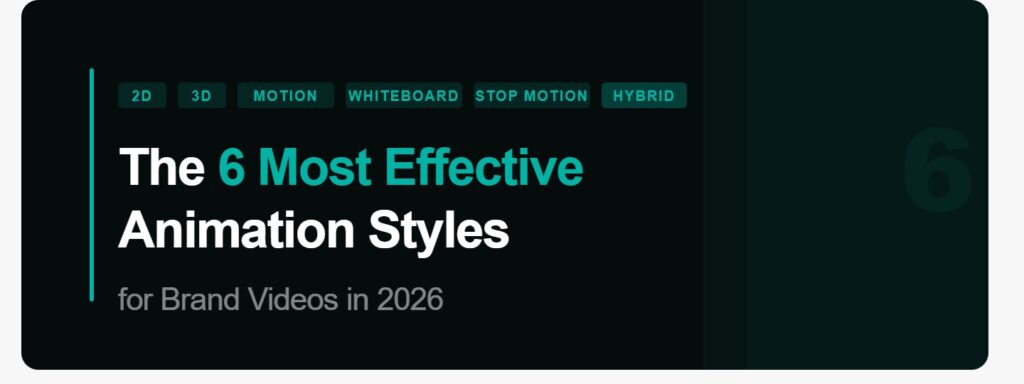
The 6 Most Effective Animation Styles for Brand Videos in 2026
1. 2D Animation
2D animation is the internet’s most versatile storytelling tool. It uses flat, vector-based illustrations or characters animated digitally — and it’s the dominant format for explainer videos, brand stories, and social media content for good reason.
It feels human without trying too hard. It’s flexible, expressive, and scales across platforms beautifully.
Best for: Startups, SaaS brands, consumer apps, educational content, social media ads, explainer videos, and storytelling-driven campaigns.
Why brands love it: 2D animation is more affordable than 3D, faster to produce than live action, and incredibly customizable. You can create entire worlds — characters, environments, scenarios — without booking locations, hiring actors, or hoping the weather cooperates.
What it communicates: Friendly. Approachable. Internet-native. Modern without being cold.
2026 Trend: Hand-drawn textures, rough line styles, and subtle 3D integration are elevating 2D animation beyond “flat explainer” territory into genuinely artistic territory.
2. 3D Animation and CGI
3D animation is where things start looking expensive — in the best possible way.
This style adds depth, realism, lighting, textures, and cinematic movement. It’s what you reach for when you want people to stop scrolling and say, “Okay, wait — this looks incredible.”
Best for: Product demos, tech brands, luxury goods, automotive, architecture, real estate, medical devices, and ecommerce brands that need a premium visual presentation.
Why brands love it: 3D animation creates immediate perceived premium value. A sleek product render with dramatic lighting can make even a simple object feel like it belongs in a Marvel credits sequence. Assets are also reusable — the same 3D model can be rotated, zoomed, and repurposed across multiple campaigns.
What it communicates: Premium. Cinematic. Innovative. High-end.
The trade-off: 3D typically costs 40–100% more than 2D and takes longer due to rendering time. But the long-term ROI through asset reuse is strong.
2026 Trend: Isometric 3D and stylized low-poly aesthetics are gaining traction in SaaS and tech, offering a middle ground between full CGI and flat design.
3. Motion Graphics
Motion graphics are the cool, professional cousin of static design. Instead of characters or narrative scenes, they animate text, icons, data visualizations, UI elements, charts, and abstract shapes.
If your brand deals with software, finance, analytics, or any idea that lives primarily in data or processes, motion graphics are your best friend.
Best for: SaaS companies, B2B brands, finance, corporate explainers, app demos, data visualization, and presentation-style content.
Why brands love it: Motion graphics simplify genuinely complex ideas without dumbing them down or boring viewers to death. They’re clean, fast-paced, and highly readable — even without sound, which matters enormously on social platforms.
What it communicates: Smart. Clean. Professional. Fast-moving.
2026 Trend: Kinetic typography and animated brand systems (where even the way your logo moves is codified) are becoming standard for premium B2B brands.
4. Whiteboard Animation
Yes, whiteboard animation had its peak moment around 2014. And yes, some executions still feel like a corporate training video from a different era.
But done right in 2026? It still works — because simplicity never really goes out of style.
Whiteboard videos simulate hand-drawn illustrations appearing in real time as a narrator explains a concept. Viewers naturally follow the drawing process, which keeps attention engaged throughout.
Best for: Educational brands, healthcare, insurance, training content, coaching businesses, and any subject matter that requires careful, step-by-step explanation.
Why it still works: It’s one of the most effective formats for retaining viewer attention through complex explanations. The progressive visual reveal creates natural anticipation.
What it communicates: Educational. Trustworthy. Clear. Methodical.
2026 Update: Modern whiteboard animation is moving beyond plain black-and-white toward colorized, stylized, and mixed-media formats that feel contemporary without losing their explanatory clarity.
5. Stop Motion Animation
Stop motion is for brands with genuine personality.
It’s handmade, tactile, slightly imperfect, and honestly kind of irresistible. Real physical objects — clay, paper, packaging, food — photographed frame by frame to create movement. Yes, someone spent hours moving tiny things millimeters at a time. The result feels completely unlike anything generated digitally.
Best for: Food brands, fashion, lifestyle products, craft and luxury campaigns, social content, and brands that want to communicate authenticity and creativity.
Why brands love it: In a world saturated with polished digital content, stop motion stands out immediately. It signals craft, intention, and personality — qualities that are increasingly rare and valuable.
What it communicates: Artistic. Handcrafted. Unique. Premium through effort, not polish.
The trade-off: Stop motion is labor-intensive and can become expensive depending on complexity and length.
6. Hybrid and Emerging Styles
The most interesting work happening in brand animation right now lives in the hybrid space — combining techniques to create something that doesn’t fit neatly into a single category.
Popular hybrid approaches in 2026:
| Hybrid Style | What It Combines | Best For |
| 2D/3D Hybrid | Flat characters + depth/lighting | Innovative consumer brands |
| Craft + Digital | Hand-drawn textures + digital precision | Premium and lifestyle brands |
| Kinetic Typography | Text-driven motion design | Short-form, social-first content |
| Stylized Isometric 3D | Simplified 3D + graphic sensibility | SaaS, tech, B2B |
| Live Action + Animation | Real footage + animated overlays | Brand storytelling, product demos |
Hybrid styles give brands creative flexibility and a genuinely distinctive visual identity — particularly valuable for brands that don’t want to be boxed in by any single aesthetic convention.
Animation Style Comparison: Full Overview
| Animation Style | Best For | Cost Level | Production Time | Emotional Impact | Platform Fit |
| 2D Animation | Storytelling, Explainers, Social | Low–Medium | 4–8 weeks | High | All platforms |
| 3D / CGI | Product demos, Premium brands | High | 8–16 weeks | Medium–High | YouTube, Website, OTT |
| Motion Graphics | Data, SaaS, Corporate | Low–Medium | 2–6 weeks | Medium | LinkedIn, Website, B2B |
| Whiteboard | Education, Healthcare, Finance | Low | 3–6 weeks | Medium | YouTube, Internal |
| Stop Motion | Craft, Food, Lifestyle | Medium–High | 6–12 weeks | High | Instagram, TikTok |
| Hybrid Styles | Modern, Versatile Brands | Medium–High | Varies | Very High | All platforms |
How to Choose the Right Animation Style: A 6-Step Framework
Step 1: Define Your Brand Personality
Before you look at a single reference video, answer this honestly: What kind of personality does your brand actually have?
Your animation style should feel like a natural extension of your brand voice — not a visual layer applied on top of it.
| Brand Personality | Best Animation Match |
| Fun, playful, energetic | 2D animation with vibrant characters |
| Premium, luxury, high-end | Cinematic 3D or craft-driven stop motion |
| Smart, modern, tech-forward | Motion graphics or stylized 3D |
| Trustworthy, educational, clear | Whiteboard or character-driven 2D |
| Artistic, creative, handcrafted | Stop motion or hybrid with texture |
| Innovative, boundary-pushing | Hybrid styles and mixed media |
If your brand is playful and energetic, hyper-serious cinematic visuals will feel disconnected. If you sell luxury products, chaotic cartoon-style animation won’t signal “premium.” The visuals and the brand identity need to exist in the same universe.
Step 2: Understand Your Audience’s Visual Expectations
Your audience already has strong visual preferences — shaped by the content they consume daily.
Gen Z and younger Millennials: Expect fast-paced, high-energy, visually dynamic content. Short-form first. Bold color. Kinetic movement.
Corporate decision-makers and B2B buyers: Prefer clean, minimal, data-forward visuals that signal competence and credibility.
Consumer lifestyle audiences: Respond to warmth, relatability, and human storytelling — 2D character animation or lifestyle-driven stop motion.
Key questions to ask before choosing:
- What content does my audience already watch and share?
- Which platforms do they spend time on?
- What emotions do I need this video to trigger?
- Am I competing for attention in a fast-moving feed or a considered viewing environment?
Step 3: Match the Style to Your Marketing Goal
The “best” animation style doesn’t exist in isolation — it only exists relative to what you’re trying to achieve.
| Marketing Goal | Best Animation Style |
| Build emotional brand connection | 2D character animation |
| Explain a complex product or process | Motion graphics or whiteboard |
| Showcase a physical product | 3D animation or stop motion |
| Drive viral social sharing | High-energy 2D or kinetic hybrids |
| Signal innovation and premium value | 3D or 2D/3D hybrid |
| Educate or train an audience | Whiteboard or 2D explainer |
| Build brand authenticity | Stop motion or craft-style hybrid |
If your goal is emotional storytelling, 2D animation is almost always the most reliable choice. If your goal is to make a product look premium, 3D is undefeated. If your goal is to simplify data for a B2B audience, motion graphics win.
Step 4: Evaluate Your Budget and Timeline Realistically
Nobody enjoys this part. But ignoring budget realities is how brands end up with half-finished projects or disappointingly generic results.
Typical cost ranges by style (per finished minute):
| Style | Estimated Cost Per Minute |
| Basic 2D (simple) | $1,000 – $5,000 |
| Professional 2D | $5,000 – $15,000 |
| Motion Graphics | $2,000 – $10,000 |
| Whiteboard | $1,000 – $5,000 |
| Stop Motion | $5,000 – $20,000+ |
| 3D Animation | $10,000 – $30,000+ |
| Hybrid Styles | $8,000 – $25,000+ |
The smartest brands don’t ask “what looks coolest?” They ask: “What style delivers the best results within our resources?” Strategy over aesthetics. Always.
Step 5: Consider Your Distribution Platforms
Where your video lives shapes what it needs to do visually.
Instagram, TikTok, YouTube Shorts: Vertical format, high energy, fast pacing, bold visual hooks in the first 2 seconds. 2D and kinetic motion graphics dominate here.
YouTube and Website: Longer storytelling formats work. More breathing room for 3D, narrative 2D, or hybrid styles.
LinkedIn: Professional, clean, data-forward. Motion graphics and minimal 2D perform strongly.
Retail, Events, and OOH Screens: 3D and stop motion create impact in ambient viewing environments.
Step 6: Test Before You Commit
Don’t skip this step, especially for larger productions.
Create 2–3 style concepts or mood boards. Present them to stakeholders and, where possible, to a sample of your actual target audience. Measure reaction against your stated goals — emotional resonance, clarity, brand fit.
A brief style test at the beginning of a project saves significantly more time and money than a full revision mid-production.
Industry-Specific Animation Style Recommendations
| Industry | Recommended Primary Style | Notes |
| SaaS / Software | Motion graphics or stylized 3D | UI animation adds credibility |
| Healthcare | Whiteboard + character 2D | Clarity and trust are paramount |
| Ecommerce / Retail | 3D animation | Product visualization drives conversion |
| Finance | Motion graphics | Data-forward, professional tone |
| Education | Whiteboard or narrative 2D | Engagement and retention first |
| Real Estate | 3D walkthroughs + motion | Spatial storytelling is the product |
| Fashion | Stop motion or cinematic 2D | Aesthetic distinctiveness matters |
| Food & Beverage | Stop motion or lifestyle 2D | Texture and tactility sell food |
| Startups | 2D animation | Flexible, fast, cost-effective |
| Tech Hardware | 3D CGI | Product beauty shots with depth |
| Nonprofit | Narrative 2D or whiteboard | Emotional connection over polish |
Common Mistakes to Avoid While Picking Animation Style For Your Brand Video
Chasing Trends without Brand Alignment.
Every few years, a visual style dominates (glitch effects, neon gradients, flat illustration). Just because something is trending doesn’t mean it fits your brand. A local accounting firm doesn’t need cyberpunk aesthetics.
Choosing Style before Defining Goals.
Animation style is a tool. Tools serve purposes. Define the purpose before selecting the tool.
Prioritizing Visual Wow over Message Clarity.
A stunning video that leaves viewers confused about your product has failed. Clarity is always the primary objective.
Trying to Combine Every Style at Once.
2D characters, 3D environments, kinetic type, live action footage, and dramatic orchestral music in a 90-second video is not bold — it’s chaos. Pick a lane and commit.
Ignoring Accessibility.
High contrast ratios, captions, and readable typography are not optional extras. They expand your reach and improve SEO through engagement signals.
Underestimating Production Timelines.
Rushing animation produces generic results. Build realistic timelines from the start, especially for 3D projects where rendering alone can add weeks
Animation Trends Shaping Brand Videos in 2026
Motion Brand Guidelines
Leading brands are now defining not just how their logos look, but how they move — consistent animation behaviors, transition styles, and kinetic signatures that work across every touchpoint.
Craft and Intentional Imperfection
As AI-generated visuals become ubiquitous, handcrafted textures, rough line styles, and visible effort are becoming signals of premium quality and authentic brand identity.
AI-assisted Production Workflows
AI tools are accelerating iteration and reducing production costs, but the strongest work still has human creative direction at its core. AI speeds up execution; it doesn’t replace strategy.
Short-form First Design
Vertical-first, hook-in-two-seconds thinking is reshaping how animation is structured. Even longer-form videos are now built from short-form-ready modules.
Hybrid and Responsive Animation
Styles designed to adapt across devices, formats, and contexts, rather than existing as a single fixed output.
Frequently Asked Questions
What is the best animation style for a brand video?
There is no single “best” style; it depends on your brand personality, target audience, marketing goals, and budget. 2D animation is the most versatile starting point for most brands, especially those in the early stages of building their visual identity.
What’s the difference between 2D and 3D animation for branding?
2D animation is more cost-effective, faster to produce, and excellent for emotional storytelling and explainer content. 3D animation delivers a premium, cinematic feel ideal for product visualization and high-end brand positioning. Many modern brands use hybrid approaches to combine the strengths of both.
How much does brand animation cost in 2026?
Costs range from approximately $1,000 per minute for basic whiteboard or 2D animation up to $30,000+ per minute for complex 3D or stop motion production. Most professional brand videos for digital use land between $5,000 and $20,000, depending on style, length, and revisions.
How long does it take to produce an animated brand video?
Production timelines typically range from 2–4 weeks for simple motion graphics to 8–16 weeks for complex 3D animation. Most professional 2D explainer videos take 4–8 weeks, including scripting, design, animation, and revisions.
Can I mix animation styles in one video?
Yes, hybrid styles are increasingly common and effective. The key is intentionality: mixing styles should serve a creative purpose, not happen by accident. A skilled studio can blend 2D characters with 3D environments, or live action footage with animated overlays, in ways that feel cohesive.
Which animation style performs best on social media?
Fast-paced 2D animation and kinetic motion graphics consistently outperform other styles on social platforms because they capture attention in the first two seconds and work effectively without sound. Stop motion also performs exceptionally well on Instagram and TikTok for lifestyle and food brands.
How often should brands update their animation style?
Animation styles should evolve gradually while maintaining core brand consistency. A major visual refresh every 3–5 years is reasonable for most brands, with incremental updates in between. Building motion brand guidelines helps manage this evolution intentionally.
What makes an animated brand video successful?
The most effective brand videos combine clear messaging, emotional resonance, and a visual style that authentically reflects brand identity. Technical quality matters, but alignment between animation style and brand personality is what determines whether a video actually builds a connection with its audience.
Final Thoughts
Choosing the right animation style for your brand video is not about finding what’s trending, copying what your competitors are doing, or defaulting to whatever fits your immediate budget.
It’s about finding the visual language that genuinely fits your brand — one that communicates who you are, connects with the people you’re trying to reach, and serves the specific goal you’re working toward.
The brands whose videos people remember didn’t get there by accident. Every color, every movement, every transition was chosen with intention. The animation style felt like the only possible choice for that brand — not because it was the most expensive or the most technically impressive, but because it was the most true.
That’s the standard worth working toward.
Define what you want people to feel. Choose the style that creates that feeling. Execute it with care.
If you’re planning a brand video and aren’t sure which animation style fits your audience, working with an experienced animation studio like Hyphemotion can save weeks of revisions and unnecessary production costs.